
PCOS & Unwanted Hair: Hair Removal Options That Actually Work
What Is PCOS (Polycystic Ovary Syndrome)?
Polycystic Ovary Syndrome (PCOS) is a common hormonal imbalance that affects many women during their reproductive years. PCOS affects about 1 in 8 women of reproductive age. However, because it’s hard to diagnose, up to 70% of women who have PCOS are undiagnosed. While it impacts overall metabolic health, one of the most noticeable and irritating symptoms is excess facial and body hair, medically known as hirsutism.
For women dealing with PCOS, the ovaries produce elevated levels of androgens (often called "male hormones" even though all humans have these hormones). This internal hormonal shift alters the behavior of your hair follicles. Instead of normal fine, soft "peach fuzz" (vellus hair), we see these hairs turn into permanent, thick, dark, and coarse terminal hair.
PCOS-driven hair growth most commonly appears on areas such as the chin, jawline, upper lip, neck, chest, abdomen, and back.
Temporary hair removal methods like shaving, waxing, threading, or depilatory creams only manage hair at or just below the skin surface. They do nothing to stop the actual follicle, which is why the hair returns so quickly.
The Science: Why PCOS Hair Growth Feels Like a Never-Ending Battle
Hair follicles are very sensitive to hormonal shifts. Once a follicle has been hormonally stimulated by high androgen levels to produce coarse terminal hair, it does not naturally reverse back into fine peach fuzz. This is why many women with PCOS notice that their hair becomes thicker and more resilient over time. When you wax or tweez a hair, you’re forcibly pulling it out by the root. Your body sees this as a minor injury and immediately rushes blood and nutrients to the empty follicle to repair the damage. That extra blood flow acts like fertilizer, feeding the follicle and actually stimulating the hair to grow back thicker, darker, and deeper over time.
To make matters worse, constantly ripping the hair out can bend and distort the hair follicle beneath the surface. When a distorted follicle tries to grow a new, coarser hair, the hair can't find its way out of the skin, leading to chronic, painful ingrown hairs.
It’s important to note that medical and/or hormonal treatments are important for managing the symptoms of PCOS. There is also no oral medicine that can permanently destroy or reverse the hair follicles that have already been activated in specific areas. That is where professional, external treatments like electrolysis and laser come in.
Electrolysis vs. Laser Hair Removal for PCOS
When you get to the point of moving past temporary grooming methods, the two most effective professional options are electrolysis and laser hair removal. They work in very different ways, and choosing the right one depends heavily on the type of hair and the area of the body being treated.
Why Electrolysis is the Gold Standard for PCOS Facial Hair
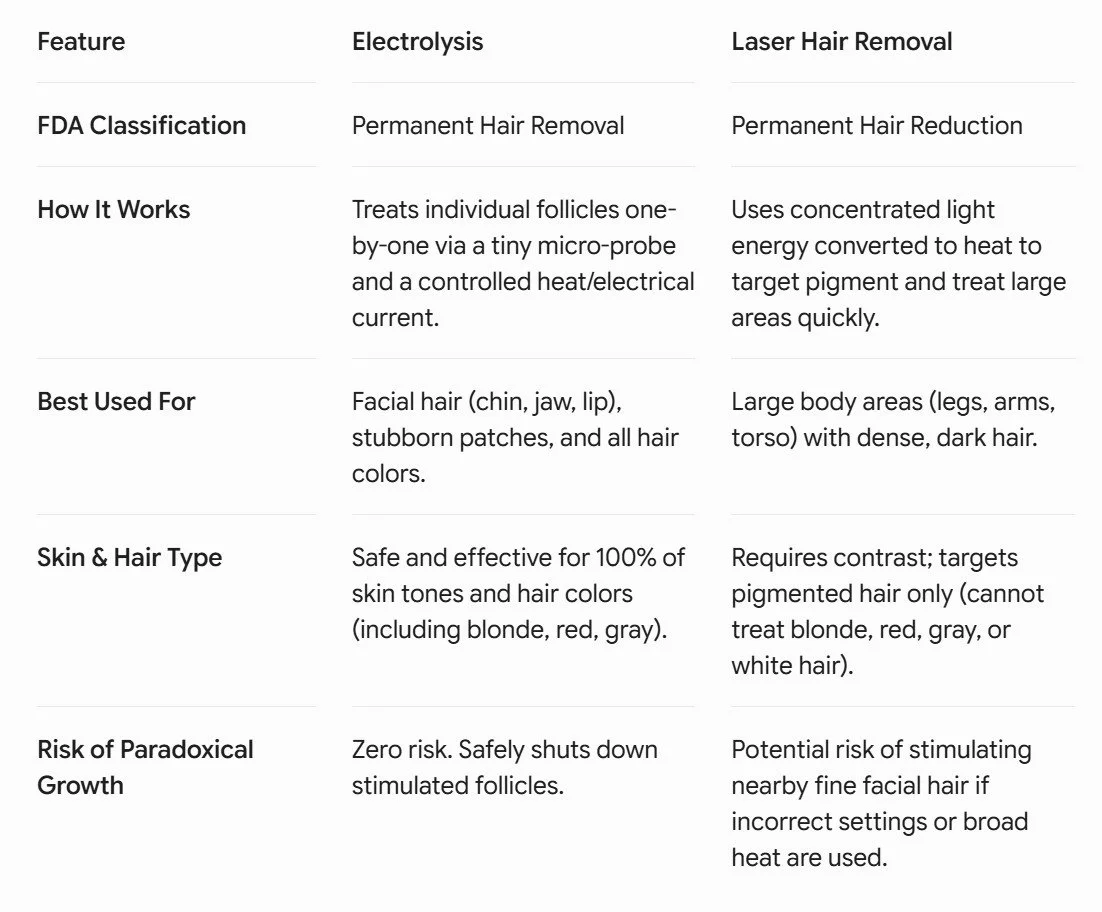
Electrolysis is the only method recognized by the FDA for permanent hair removal. During treatment, a tiny, single-use, sterile probe is gently inserted into the natural opening of the hair follicle. A controlled current is applied, destroying the follicle’s growth cells entirely.
Electrolysis is a great option for PCOS facial hair management because it protects the skin barrier and eliminates the risk of paradoxical hair growth. It delivers precision treatment directly inside the follicle without disrupting or inflaming the surrounding skin. And, because it targets hair one by one, it won’t accidentally trigger surrounding peach fuzz to turn thick.
Note: Because PCOS is an ongoing internal condition, your body may try to activate entirely new hair follicles down the road. While electrolysis permanently destroys the hairs we treat, occasional maintenance will probably be needed for brand-new follicles triggered by future hormonal shifts.
Utilizing Laser Hair Removal for Dense Body Areas
Laser hair removal reduces hair density by using the pigment inside the hair shaft. At our medspa, we use the industry-leading Candela GentleMax Pro Plus technology to ensure safe, highly effective treatments.
Laser hair removal is an excellent tool for PCOS when you want to:
Significantly thin out dense hair over large areas (like the legs, back, or abdomen).
Slow down the rapid rate of regrowth.
Soften the overall texture of the hair, making it much finer and easier to manage.
However, laser hair removal is FDA-approved for permanent hair reduction, not complete, permanent removal. For individuals with high androgen levels, relying solely on laser treatment on the face can sometimes lead to paradoxical hair growth, a biological quirk where the heat inadvertently wakes up nearby fine hairs. So, a strategic approach is needed. We recommend coming in for a consultation before you start lasering the face.
Laser also works only on pigmented hair, meaning it cannot treat blonde, gray, white, or red hair.
The Best Hair Removal Strategy for PCOS
Because hormone levels, skin tones, and hair textures vary wildly from person to person, there is no single ‘PCOS treatment template’. A proper, safe evaluation must be done in person before starting.
During a free consultation at our clinic in Rochester, MN, we look at your specific hair color, density, and skin tone to craft a personalized strategy. We typically recommend one of three pathways:
Option 1: Combination Plan
Laser treatment first, followed by electrolysis.
This is highly efficient for dense growth on body areas. We start with the Candela GentleMax Pro Plus laser to rapidly reduce bulk hair density and slow down regrowth over a few sessions. Once the hair is significantly thinned out, we pivot to electrolysis to permanently eliminate the remaining stubborn or lighter hairs.
Option 2: Electrolysis Alone
No laser treatment, just electrolysis.
This is the safest, most reliable approach for hormonal facial hair (such as the chin, jawline, and upper lip) or for anyone with blonde, red, gray, or white hair. It guarantees permanent results from day one without risking a paradoxical growth reaction on the face.
Option 3: Laser Alone
No electrolysis, just laser hair removal.
This is best used for large areas like the legs, arms, or torso where the hair is consistently coarse and dark, and where the goal is major, long-lasting reduction over a large surface area.
What to Expect During Your Treatment
All hair grows in distinct cycles, which means whether you choose laser, electrolysis, or a combination of both, a series of consistent sessions is necessary to catch every follicle in its active growth phase.
As you progress through your treatment, you will notice that the hair grows back much slower, finer, and sparser, allowing you to stretch the time between your visits further apart.
Dealing with PCOS-related hair growth can feel isolating and exhausting, but you are not alone. Professional hair removal can give you your time, confidence, and skin health back.
Ready to build a customized plan that fits your life? Book your free consultation with us in Rochester, MN, today.
Frequently Asked Questions About PCOS Hair Removal
Is electrolysis permanent for women with PCOS?
Yes. Each individual hair follicle treated with electrolysis is permanently destroyed and cannot grow another hair. However, because PCOS is an internal hormonal imbalance, your body may continue to stimulate new, untreated follicles over time. While it cannot change your underlying hormones, electrolysis permanently eliminates the hair currently bothering you.
Can laser hair removal make PCOS facial hair worse?
In some cases, yes. When used on fine, hormonal facial hair, the broad heat from a laser can occasionally trigger a biological response known as paradoxical hypertrichosis (paradoxical hair growth), causing fine peach fuzz to turn into thick terminal hair. For this reason, we highly recommend an individual evaluation and often favor electrolysis as the primary solution for facial hair.